Artificial Intelligence gained significant popularity in the 2010s. Advancements in machine learning and big data contributed to its rise.
Artificial Intelligence (AI) has transformed various sectors, from healthcare to finance. The 2010s marked a turning point for AI due to breakthroughs in machine learning, data analytics, and computational power. Companies started integrating AI into their operations to improve efficiency and innovation.
Tech giants like Google and Microsoft heavily invested in AI research, leading to rapid advancements. AI applications, such as virtual assistants and recommendation systems, became mainstream. Public interest grew as AI began influencing daily life and business practices. AI’s popularity continues to soar, driving technological progress and economic growth.
Early Beginnings
The journey of Artificial Intelligence (AI) started years ago. Early thinkers dreamed of machines that could think. These ideas laid the foundation for modern AI. Let’s explore two key milestones in the early days of AI.
The Turing Test
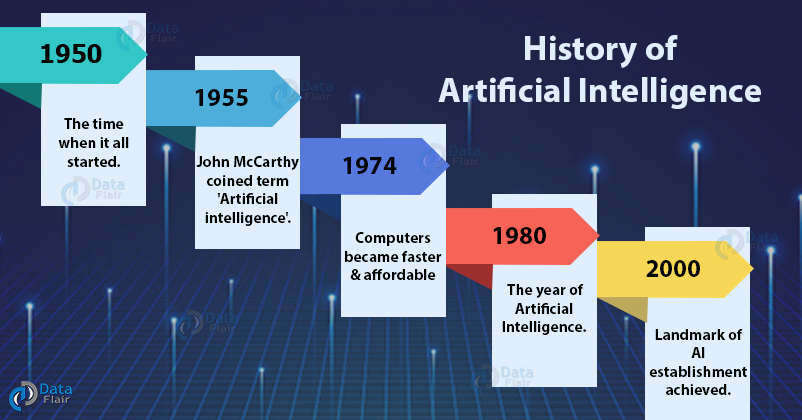
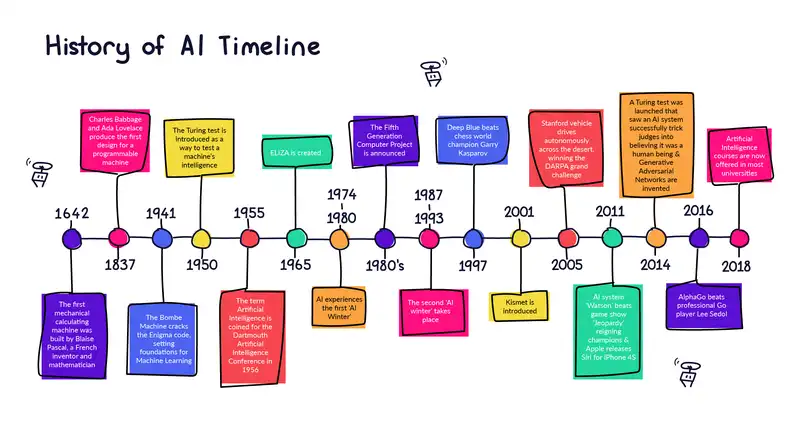
In 1950, Alan Turing introduced the Turing Test. This test aimed to check if a machine could think like a human. The idea was simple yet powerful. Turing proposed that if a machine could hold a conversation indistinguishable from a human, it was intelligent. This test became a cornerstone in AI development.
Initial Concepts
Many early ideas of AI came from science fiction. Writers imagined robots and smart machines. These stories inspired scientists and inventors. In the 1950s and 1960s, researchers began creating basic AI programs. These programs could solve math problems and play games like chess. These early programs showed that machines could mimic some aspects of human intelligence.
Here are some key milestones during the early days:
- 1956: The term “Artificial Intelligence” was coined at the Dartmouth Conference.
- 1957: The first AI program, the Logic Theorist, was created.
- 1966: ELIZA, an early chatbot, was developed to simulate human conversation.
These milestones set the stage for future advancements in AI.
The Birth Of Ai
The journey of Artificial Intelligence (AI) began in the mid-20th century. Curious minds sought to create machines that could think and learn. This dream sparked a revolution that continues today.
Dartmouth Workshop
The Dartmouth Workshop in 1956 marked AI’s official birth. A group of scientists gathered at Dartmouth College. They discussed the potential of machines that could simulate human intelligence.
The workshop was led by John McCarthy, Marvin Minsky, Nathaniel Rochester, and Claude Shannon. Their goal was to explore AI over a summer project. They believed machines could be made to mimic human thought processes.
Here are some key points from the Dartmouth Workshop:
- Focus on simulating human learning and reasoning.
- Development of algorithms to solve problems.
- Introduction of the term “Artificial Intelligence”.
Early Pioneers
The early pioneers of AI laid the groundwork for future advancements. They created the first AI programs and explored various approaches. These pioneers include:
| Name | Contributions |
|---|---|
| John McCarthy | Coined the term AI and developed LISP programming language. |
| Marvin Minsky | Worked on AI theory and co-founded the MIT AI Lab. |
| Alan Turing | Proposed the Turing Test to measure machine intelligence. |
| Herbert Simon | Developed early AI programs like the Logic Theorist. |
These pioneers made significant contributions to AI research. Their work paved the way for modern AI technologies.
The First Ai Winter
Artificial Intelligence, or AI, has had a roller-coaster history. One of the most notable periods is the First AI Winter. This era in AI’s journey was marked by a significant decline in interest and funding. The excitement around AI dwindled due to unmet expectations and technological hurdles.
Funding Cuts
During the First AI Winter, there were severe funding cuts. Governments and private investors had high hopes for AI. They believed AI would quickly solve complex problems. But progress was slower than expected. The lack of results led to disappointment. Funding was redirected to other promising fields. This created a significant setback for AI research.
Technological Limitations
AI faced many technological limitations in its early days. Computers were not powerful enough to handle complex calculations. Memory and storage were also limited. Programming languages were not advanced. These factors made it hard to develop effective AI systems.
Researchers had big dreams, but technology lagged behind. They struggled with simple tasks that modern AI handles easily. This gap between expectations and reality contributed to the AI Winter.
| Factor | Impact |
|---|---|
| Funding Cuts | Reduced research and slowed progress |
| Technological Limitations | Hindered AI development |
These challenges made many believe AI was not feasible. The First AI Winter was a tough time for the field. But it also taught valuable lessons for future research.
Revival In The 1980s
The 1980s saw a significant revival in the field of artificial intelligence. This period marked a resurgence of interest and investment in AI technologies. The decade brought about groundbreaking advancements, particularly in the development of expert systems and their commercial applications.
Expert Systems
Expert systems became a major focus in the 1980s. These systems aimed to emulate the decision-making abilities of human experts. They used rule-based logic to solve complex problems. Expert systems were among the first successful forms of AI. They found applications in various fields like medicine, finance, and engineering.
Key features of expert systems included:
- Knowledge Base: A repository of facts and rules.
- Inference Engine: The component that applies rules to known facts.
- User Interface: Allows interaction between the user and the system.
These features enabled expert systems to provide solutions and recommendations. They became valuable tools for professionals across industries.
Commercial Applications
The 1980s also witnessed the rise of AI in commercial applications. Businesses began to see the potential of AI for improving efficiency and decision-making. Expert systems were integrated into various business processes. This led to enhanced productivity and cost savings.
Some notable commercial applications included:
- Medical Diagnosis: Systems like MYCIN helped diagnose bacterial infections.
- Financial Services: AI assisted in credit scoring and risk assessment.
- Manufacturing: AI optimized production schedules and quality control.
These applications demonstrated the practical value of AI. They paved the way for more advanced technologies in the future.
The revival of AI in the 1980s laid the foundation for today’s innovations. Expert systems and commercial applications showcased the potential of AI, sparking interest and investment that continue to grow.
The Second Ai Winter
The Second AI Winter refers to a period when enthusiasm for artificial intelligence dwindled. This phase saw funding cuts, skepticism, and a significant slowdown in AI research and development.
Market Collapse
During the Second AI Winter, the AI market experienced a severe collapse. Companies invested heavily in AI but saw little return on investment. This led to a massive loss of confidence in AI technologies.
| Year | Event |
|---|---|
| 1987 | AI market starts to decline |
| 1988 | Several AI companies shut down |
| 1990 | AI funding significantly reduced |
Academic Stagnation
Academic research also faced significant stagnation during this period. Many researchers shifted focus due to the lack of funding and progress. This led to fewer publications and breakthroughs in the field.
- Limited financial support for AI research
- Reduced number of AI-focused academic programs
- Decline in AI-related publications
Despite these challenges, the Second AI Winter laid the groundwork for future advancements. Lessons learned during this time helped shape the AI landscape we know today.
Credit: suresh-kandru.medium.com
Ai In The 1990s
The 1990s saw a significant rise in the popularity of Artificial Intelligence. During this decade, many important developments took place. These advancements laid the groundwork for future AI technologies.
Neural Networks
Neural networks became a major focus in the 1990s. These computer systems mimic the human brain. They learn from data and improve over time. Researchers used neural networks for various applications.
One key advancement was the backpropagation algorithm. This algorithm allowed neural networks to learn more efficiently. It made training these networks faster and more accurate. As a result, neural networks became more popular and widely used.
Renewed Interest
There was a renewed interest in AI during the 1990s. This interest came from both academia and industry. Many companies started to invest in AI research. Governments also funded AI projects. This led to many breakthroughs and innovations.
The rise of personal computers also played a role. More people had access to powerful computing resources. This made it easier for researchers to experiment with AI. The increased interest and investment helped AI grow rapidly.
| Key Developments | Impact |
|---|---|
| Backpropagation Algorithm | Improved neural network training |
| Increased Funding | More research and innovation |
| Personal Computers | Wider access to computing power |
These factors contributed to the growing popularity of AI in the 1990s. The advancements made during this time paved the way for future AI developments.
Ai Goes Mainstream
Artificial Intelligence has been around for decades. But it wasn’t always popular. AI became a household term in the late 1990s. The technology started to show its true potential. This made people take notice.
Ibm’s Deep Blue
In 1997, IBM’s Deep Blue made headlines. It defeated world chess champion Garry Kasparov. This was a huge achievement. It showed AI could compete with humans. The world was amazed. Chess was a complex game. AI mastering it was a big deal.
Ai In Media
AI began to appear in movies and TV shows. Films like “The Matrix” and “A.I. Artificial Intelligence” were popular. They showed AI in various roles. This captured the public’s imagination. People started to see AI as part of the future.
| Year | Event |
|---|---|
| 1997 | IBM’s Deep Blue beats Garry Kasparov |
| 1999 | “The Matrix” released |
| 2001 | “A.I. Artificial Intelligence” released |
AI’s portrayal in media helped it gain popularity. People started to explore AI more. It became a topic of discussion. AI went from a niche technology to a mainstream phenomenon.
The Internet Era
The Internet Era brought a revolution in technology. This period saw a massive increase in data generation. With the rise of social media, e-commerce, and online services, data became abundant. This explosion of data paved the way for artificial intelligence to become popular.
Data Explosion
The Internet Era saw a massive data explosion. Social media platforms like Facebook, Twitter, and Instagram generated huge amounts of data daily. E-commerce websites tracked user behavior and preferences. Online services collected user data for better service delivery. This abundance of data became a goldmine for AI development.
- Social Media Data
- E-commerce Data
- Online Services Data
With so much data available, AI algorithms had more information to learn from. This led to better and more accurate AI models. The data explosion was a significant factor in AI’s popularity rise.
Machine Learning
Machine Learning became a crucial part of AI development during the Internet Era. With access to vast amounts of data, machine learning algorithms improved significantly. They could now identify patterns and make decisions based on data.
Supervised learning and unsupervised learning became common methods used in AI. In supervised learning, algorithms were trained on labeled data. In unsupervised learning, algorithms found patterns in unlabeled data.
- Supervised Learning
- Unsupervised Learning
Machine learning’s ability to learn from data led to innovations in various fields. From healthcare to finance, AI applications began to emerge, making life easier and more efficient.
| Field | AI Application |
|---|---|
| Healthcare | Predictive Diagnostics |
| Finance | Fraud Detection |
| Retail | Personalized Recommendations |
The Internet Era laid the foundation for AI’s popularity. The data explosion and advancements in machine learning played a vital role. As a result, AI has become an integral part of our daily lives.
The Rise Of Big Data
The rise of Big Data has fueled the growth of artificial intelligence. As data became plentiful, AI systems had more information to learn from. This transformation began in the early 2000s and continues to this day. Let’s explore how Big Data has contributed to AI’s popularity.
Data Analytics
With the surge in data, data analytics became crucial. Businesses needed tools to analyze massive datasets. Advanced algorithms helped uncover patterns and insights. This made decision-making more informed and efficient.
Data analytics involves:
- Collecting data from various sources
- Cleaning and organizing data
- Applying statistical methods
- Visualizing results for easy interpretation
Predictive Models
Big Data enabled the creation of predictive models. These models forecast future events based on historical data. This ability revolutionized many industries.
Key applications of predictive models include:
- Customer behavior prediction
- Risk management in finance
- Maintenance schedules in manufacturing
- Personalized marketing strategies
Predictive models rely on:
| Component | Function |
|---|---|
| Data Collection | Gathering relevant data |
| Data Processing | Cleaning and organizing data |
| Model Training | Teaching the algorithm |
| Model Evaluation | Testing accuracy |
As Big Data grows, predictive models become more accurate. This continuous improvement drives AI’s popularity and effectiveness.
Ai In The 2010s
The 2010s saw a major rise in the popularity of artificial intelligence. This decade brought significant advancements, making AI more mainstream. Key developments included deep learning and a surge in AI startups.
Deep Learning
Deep learning became a breakthrough in the 2010s. It allowed machines to learn from vast amounts of data. This technology led to significant improvements in image recognition, speech processing, and more.
Deep learning uses neural networks with many layers. These layers process data in complex ways. This method outperformed earlier machine learning techniques.
Companies like Google, Facebook, and Amazon adopted deep learning. They used it to improve their products and services. For example, Google improved its search results, and Facebook enhanced its photo tagging system.
Ai Startups
The 2010s also saw a rise in AI startups. Many new companies emerged, focusing on AI solutions. These startups attracted significant investments from venture capitalists.
Some notable AI startups included:
- DeepMind: Acquired by Google in 2015.
- OpenAI: Focused on safe and beneficial AI.
- Nvidia: Known for its AI hardware and software.
These startups contributed to the rapid growth of AI. They developed innovative products and services. This further increased AI’s popularity and utility.
AI startups often collaborated with larger tech companies. This helped integrate AI into various industries. As a result, AI became more accessible to businesses and consumers.
| Company | Focus | Acquisition |
|---|---|---|
| DeepMind | AI Research | |
| OpenAI | Safe AI | Independent |
| Nvidia | AI Hardware | Independent |
Ai In Everyday Life
Artificial Intelligence has become an integral part of our daily activities. From managing our schedules to recommending our next favorite movie, AI is everywhere. Let’s explore how AI has transformed our lives through smart assistants and personalized services.
Smart Assistants
Smart assistants like Amazon Alexa and Google Assistant have revolutionized how we interact with technology. These AI-powered devices help us with various tasks.
- Setting reminders and alarms
- Providing weather updates
- Playing music and podcasts
- Answering questions
These assistants use natural language processing to understand and respond. They make our daily routines more efficient and enjoyable.
Personalized Services
AI also plays a huge role in personalized services. Companies use AI algorithms to tailor experiences to individual preferences.
| Service | Examples |
|---|---|
| Streaming Platforms | Netflix, Spotify |
| Shopping Recommendations | Amazon, eBay |
| Social Media Feeds | Facebook, Instagram |
These services analyze your activity and suggest content or products. This makes your interactions more relevant and engaging.
In summary, AI’s presence in everyday life enhances convenience and personalization. It continues to evolve, making our lives easier and more connected.
Ethical Considerations
Artificial Intelligence (AI) has grown rapidly. This growth brings ethical concerns. AI impacts our daily lives. Addressing these concerns is crucial for its future.
Bias In Ai
AI can show bias. This happens due to biased data. Biased data affects AI decisions. These decisions can be unfair.
- Biased hiring processes
- Unfair loan approvals
- Discriminatory facial recognition
To reduce bias, use diverse data. Regularly audit AI systems. Ensure fairness in AI applications.
Regulatory Challenges
AI regulation is still developing. Different countries have different rules. This creates challenges for global AI use.
Here are some key regulatory issues:
- Data privacy laws
- AI accountability
- Transparency in AI algorithms
Effective regulation ensures safe AI. It protects users and promotes trust.
The Future Of Ai
Artificial Intelligence (AI) has rapidly advanced over the past few decades. Its future holds immense potential to reshape our world. With each passing year, new technologies and applications emerge, promising to revolutionize various sectors.
Emerging Technologies
AI is driving the development of new technologies. These innovations are transforming industries and daily life. Below are some key emerging technologies powered by AI:
- Machine Learning: Algorithms learn from data to improve tasks.
- Natural Language Processing: Helps machines understand human language.
- Computer Vision: Enables machines to interpret visual information.
- Robotics: AI makes robots smarter and more efficient.
These technologies are creating solutions that were once thought impossible. They are driving efficiency and unlocking new possibilities.
Global Impact
AI’s influence is growing around the world. It affects various sectors, improving efficiency and innovation. Here’s a look at some areas impacted by AI:
| Sector | Impact |
|---|---|
| Healthcare | AI helps diagnose diseases and develop treatments. |
| Finance | AI improves fraud detection and financial forecasting. |
| Transportation | AI powers self-driving cars and traffic management. |
| Education | AI provides personalized learning experiences. |
AI’s global impact is vast and transformative. It has the potential to solve complex problems and create new opportunities.
Credit: data-flair.training
Credit: codebots.com
Frequently Asked Questions
When Did Ai Become Widely Used?
AI became widely used in the 2010s. Advances in machine learning and data availability fueled its adoption across industries.
When Was The Golden Age Of Ai?
The golden age of AI was the 1950s to 1970s. During this period, AI research and development surged.
What Is The First Ai Of All Time?
The first AI is considered to be the “Logic Theorist,” created by Allen Newell and Herbert A. Simon in 1956.
Was The Term Artificial Intelligence Used In 1956?
Yes, the term “artificial intelligence” was first used in 1956 at the Dartmouth Conference.
What Is The History Of Ai Popularity?
AI gained significant popularity in the 21st century due to advancements in computing power and data availability.
When Did Ai Start To Become Mainstream?
AI became mainstream in the 2010s with the rise of machine learning and deep learning applications.
Why Did Ai Become Popular In Recent Years?
AI became popular due to technological advancements, increased data availability, and successful applications in various industries.
Who Are The Pioneers Of Ai?
Pioneers of AI include Alan Turing, John McCarthy, Marvin Minsky, and Geoffrey Hinton.
Conclusion
Artificial Intelligence gained popularity through significant advancements in computing power and data availability. From early research to modern applications, AI’s growth has been remarkable. Its influence spans various industries, revolutionizing how we live and work. As AI continues to evolve, it promises even more innovative and transformative solutions for the future.