
Technology is always evolving. Each year brings new trends that shape our world.
In 2023, many exciting tech trends are emerging. These trends impact both our personal and professional lives. Staying updated with these trends is crucial. It helps you understand the future and adapt to changes. From artificial intelligence to blockchain, the tech landscape is rapidly changing.
This blog post will explore the top 10 tech trends you need to know. These trends are set to dominate the tech world. They offer new opportunities and challenges. Read on to discover what’s new in technology and how it can affect you. Stay ahead of the curve and be informed about the latest tech advancements.
Ai And Machine Learning
AI and Machine Learning are transforming the world. These technologies analyze data and make decisions. Their impact is widespread. Let’s explore their influence and future applications.
Revolutionizing Industries
AI and Machine Learning have revolutionized various industries:
- Healthcare: AI assists doctors in diagnosing diseases early.
- Finance: Machine Learning detects fraud and manages risk.
- Retail: AI personalizes shopping experiences for customers.
- Transportation: Self-driving cars use AI to navigate safely.
- Manufacturing: AI predicts maintenance needs and improves efficiency.
Future Applications
The future of AI and Machine Learning is promising. Here are some potential applications:
- Education: AI tutors personalized learning for students.
- Environmental Conservation: Machine Learning monitors wildlife and predicts natural disasters.
- Cybersecurity: AI identifies and prevents cyber threats in real-time.
- Entertainment: AI creates personalized content and interactive experiences.
- Agriculture: Machine Learning optimizes crop yields and reduces waste.
These trends will shape our world. AI and Machine Learning hold immense potential for future advancements.
5g Technology
5G technology is the fifth generation of mobile networks. It promises faster speeds, lower latency, and more reliable connections. This new technology will transform how we live and work. Let’s dive into some of its key aspects.
Enhancing Connectivity
5G technology enhances connectivity across the globe. It offers faster data transfer rates. Users can download files in seconds. Streaming high-definition videos will be smoother.
This technology supports more devices simultaneously. This means less network congestion. People can connect multiple devices without losing speed. It will also improve video calls and online gaming experiences.
Impact On Iot
The Internet of Things (IoT) will greatly benefit from 5G. IoT devices rely on fast and stable connections. With 5G, these devices will perform better.
Smart homes will become more efficient. Devices like smart thermostats, lights, and security systems will respond faster. Factories will use IoT for automation. Machines will communicate in real-time, increasing productivity.
5G will also impact healthcare. Remote monitoring of patients will be more accurate. Doctors can access patient data instantly. This means better and faster medical care.
In agriculture, smart sensors will monitor crops. Farmers will get real-time data on soil and weather conditions. This will lead to better crop management and higher yields.
5G technology will connect everything around us. It will create a smarter, more connected world.
Blockchain And Cryptocurrencies
Blockchain and cryptocurrencies have been significant in tech trends. These technologies promise to change various industries. They offer secure and transparent ways to handle transactions and data.
Decentralized Finance
Decentralized Finance, or DeFi, is a major application of blockchain. It removes the need for traditional banks. People can lend, borrow, and trade directly. DeFi platforms operate on smart contracts. These contracts are self-executing and reduce errors. DeFi aims to make financial services accessible to everyone.
Security Enhancements
Blockchain and cryptocurrencies offer strong security features. Transactions are encrypted and verified by many users. This makes hacking very difficult. Each block in a blockchain is linked to the previous one. Altering a single block requires changing the entire chain. This ensures data integrity.
Cryptocurrencies use cryptographic techniques to secure transactions. Public and private keys are vital here. The public key is like an address. The private key is a password. Only the owner can use the private key to access their funds. This dual-key system adds an extra layer of security.
Quantum Computing
Quantum computing stands out in the top 10 tech trends. It offers faster problem-solving capabilities compared to traditional computers. This technology promises advancements in various fields, including cryptography and material science.
Quantum computing is a groundbreaking technology that’s changing the tech landscape. Unlike traditional computers, quantum computers use quantum bits or qubits. These qubits can exist in multiple states at once, thanks to superposition. This gives quantum computers the potential for immense processing power. They can solve complex problems that are beyond the reach of classical computers.Computational Power
Quantum computers have immense computational power. They can process vast amounts of data quickly. This ability comes from their use of qubits. Traditional computers use bits that are either 0 or 1. But qubits can be both at the same time. This property, called superposition, allows quantum computers to perform many calculations at once. They can solve problems that would take classical computers thousands of years. This makes them incredibly powerful for tasks like encryption and data analysis.Real-world Uses
Quantum computing has many real-world uses. One key area is cryptography. Quantum computers can crack codes much faster than classical computers. This will change data security methods. Another area is drug discovery. Quantum computers can analyze complex molecules faster. This helps in finding new drugs and treatments. They are also useful in logistics. Companies can optimize routes and reduce costs. They can handle complex simulations, like predicting weather patterns. This helps in making better decisions and planning. Quantum computing is not just theory. It’s already having an impact in various fields.Augmented And Virtual Reality
Augmented and Virtual Reality (AR and VR) are transforming the digital world. These technologies blend the physical and digital realms, creating unique experiences. AR overlays digital information on real-world objects. VR immerses users in a fully digital environment. Both have made significant strides in recent years.
Immersive Experiences
AR and VR offer unparalleled immersive experiences. They transport users to different worlds. Imagine visiting a virtual museum from your living room. Or exploring ancient ruins without leaving home. These experiences captivate and engage users in ways traditional media can’t.
Education and entertainment are prime examples. Students can learn history by virtually walking through ancient cities. Gamers can dive into worlds that feel incredibly real. These immersive experiences are just the beginning. As technology advances, the possibilities grow.
Industry Adoption
Many industries are adopting AR and VR. Healthcare uses VR for surgery simulations. This helps doctors practice without risks. AR assists in guiding real surgeries with precision. Retail is another sector embracing these technologies. Virtual fitting rooms let customers try clothes digitally. This enhances the shopping experience and reduces returns.
Real estate also benefits. Virtual tours allow potential buyers to explore properties remotely. This saves time and resources. Manufacturing uses AR for training and maintenance. Workers can see instructions overlaid on machinery. This speeds up processes and reduces errors.
AR and VR are reshaping various industries. The potential applications are vast. As these technologies evolve, their impact will only increase.

Credit: www.gartner.com
Edge Computing
Edge computing is a growing trend in the tech world. It brings data processing closer to the source. This reduces latency and improves speed. It is essential for applications like IoT and real-time analytics.
Processing At The Edge
Edge computing involves processing data near the data source. This can be a device like a sensor or a local server. It reduces the need to send data to a distant cloud server. This helps in faster decision-making.
For example, a smart thermostat processes data locally. It adjusts the temperature instantly. This is quicker than sending data to a cloud server and waiting for a response.
Benefits And Challenges
Benefits:
- Reduced Latency: Faster data processing as it happens close to the source.
- Improved Security: Data stays local, reducing the risk of breaches during transmission.
- Bandwidth Efficiency: Less data sent to the cloud means lower bandwidth usage.
- Reliability: Local processing ensures functionality even during connectivity issues.
Challenges:
- Scalability: Managing many edge devices can be complex.
- Data Management: Storing and processing data locally requires efficient systems.
- Cost: Initial setup of edge devices can be expensive.
- Maintenance: Regular updates and maintenance are necessary for edge devices.
Understanding these aspects of edge computing can help you decide if it’s right for your needs. Embrace the future with edge computing!
Biometric Security
Biometric security is a hot topic in the tech world. It uses unique body features for identification. This includes fingerprints, facial recognition, and even voice patterns. It offers a high level of security. But it also raises questions about privacy and data protection.
Advancements In Authentication
Recent years have seen major advancements in biometric authentication. Tech companies are using AI to improve accuracy. Fingerprint scanners are now common in smartphones. Facial recognition is used at airports for quick boarding.
- Fingerprint Scanners: Found in many smartphones.
- Facial Recognition: Used at airports for quick boarding.
- Voice Patterns: Employed in customer service for identity verification.
These methods are fast and convenient. They offer a higher level of security compared to passwords. They are also harder to fake. This makes them a preferred choice for many.
Privacy Concerns
While biometric security is convenient, it also raises privacy concerns. Your biometric data is unique to you. If it gets stolen, you can’t change it like a password. This makes it crucial to protect this data.
| Concern | Details |
|---|---|
| Data Theft | Biometric data is hard to change if stolen. |
| Data Storage | Storing biometric data securely is a challenge. |
| Consent | Users must consent to data collection. |
Companies must follow strict protocols to protect this data. Users should know how their data will be used. They should also have the option to opt out. These measures can help build trust in biometric security.

Credit: www.thesmartcityjournal.com
Autonomous Vehicles
Autonomous vehicles are changing the way we think about transportation. These self-driving cars use advanced technology to navigate and operate without human input. They promise to make travel safer and more efficient. Let’s explore the progress in this exciting field.
Technological Progress
Autonomous vehicles rely on several key technologies. Artificial Intelligence (AI) and Machine Learning (ML) play vital roles. They help the car to learn and adapt to various driving conditions. Sensors and cameras detect obstacles and read road signs. GPS systems ensure accurate navigation. The integration of these technologies has made significant strides in recent years.
Many companies are investing in autonomous vehicle technology. Tesla, Waymo, and Uber are leading the way. They are conducting extensive testing to refine their systems. This rapid progress has brought us closer to a future where self-driving cars are a common sight on the road.
Safety And Regulations
Safety is a top priority for autonomous vehicles. These cars aim to reduce accidents caused by human error. They follow traffic rules and maintain safe distances from other vehicles. However, ensuring their safety requires rigorous testing and validation.
Governments are also playing a crucial role. They are developing regulations to oversee autonomous vehicle deployment. These rules ensure that the technology is safe for public use. For example, in the United States, the National Highway Traffic Safety Administration (NHTSA) sets guidelines for testing and deployment. Other countries are also establishing similar frameworks.
Despite these efforts, challenges remain. Developers must address issues like software glitches and cybersecurity threats. Only then can autonomous vehicles be deemed safe for widespread use.
Robotics And Automation
Robotics and automation are transforming industries around the globe. These technologies improve efficiency, reduce human error, and cut costs. They are now part of many sectors, from manufacturing to healthcare.
Labor Market Impact
Robotics and automation change the labor market. Some jobs become automated, leading to job losses. But new opportunities also emerge. Workers need to adapt and learn new skills.
Training programs help people adjust. This shift creates demand for tech skills. Jobs in programming, maintenance, and system management grow. People who can work with robots find new opportunities.
Future Innovations
Future innovations in robotics and automation promise even more changes. Robots may become more intelligent and versatile. New materials and better designs will improve their function.
Home robots may assist with daily tasks. Autonomous vehicles will change transportation. Agriculture will see more robotic farming. These innovations will continue to reshape our world.
Sustainable Tech
The future of technology is increasingly focused on sustainability. Innovative solutions are emerging to address environmental challenges. Sustainable tech aims to reduce the ecological footprint of various industries. This section explores some of the key trends in sustainable technology.
Green Energy Solutions
Green energy solutions are at the forefront of sustainable tech. They offer cleaner alternatives to traditional energy sources.
Some notable green energy technologies include:
- Solar Power: Uses sunlight to generate electricity.
- Wind Energy: Harnesses wind to produce power.
- Hydropower: Utilizes water flow for energy.
- Geothermal Energy: Exploits heat from the earth’s core.
These technologies help in reducing carbon emissions. They are vital for a sustainable future.
Environmental Impact
Understanding the environmental impact of tech innovations is crucial. Sustainable tech aims to minimize negative effects on nature. Here are some aspects to consider:
- Reduction in Pollution: Green energy reduces air and water pollution.
- Resource Efficiency: Technologies that use fewer natural resources.
- Waste Management: Innovations to manage and recycle waste effectively.
- Conservation Efforts: Tech solutions that support wildlife and habitat conservation.
By focusing on these areas, sustainable tech contributes to a healthier planet. It supports long-term ecological balance.
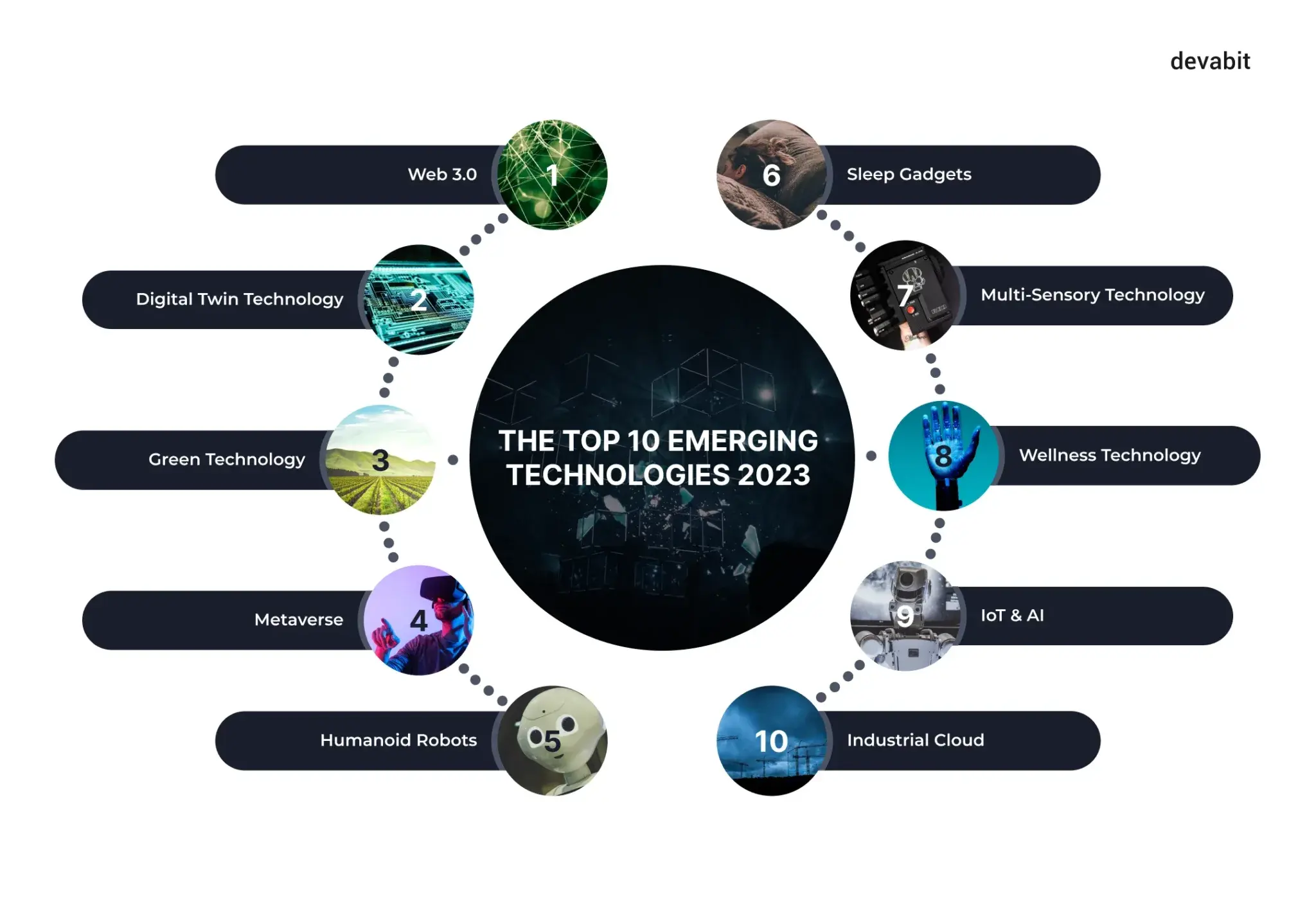
Credit: devabit.com
Frequently Asked Questions
What Are The Top Tech Trends?
The top tech trends include AI, 5G, IoT, blockchain, and quantum computing. These technologies are transforming industries, enhancing productivity, and creating new opportunities.
How Does Ai Impact Businesses?
AI automates tasks, improves decision-making, and enhances customer experiences. Businesses leverage AI for data analysis, personalized marketing, and operational efficiency.
What Is The Future Of 5g?
The future of 5G promises faster internet speeds, lower latency, and improved connectivity. It will enable advanced applications like autonomous vehicles and smart cities.
Why Is Iot Important?
IoT connects devices, enabling data exchange and automation. It improves efficiency, reduces costs, and enhances user experiences across various industries.
Conclusion
Tech trends evolve fast. Staying updated is crucial. These top 10 trends shape our future. Embrace them to stay ahead. Understand their impact. Adapt to changes. Keep learning. Technology will keep advancing. Stay curious. Innovate with these trends. Your journey in tech starts now.