
Video games have come a long way since their early days. The first generation of video games laid the groundwork for the industry we know today.
In the late 1950s and 1960s, the world saw the birth of video games. These early games were simple, yet groundbreaking. They introduced basic concepts still used in gaming today. Early pioneers like “Tennis for Two” and “Spacewar!” Captured imaginations.
These games sparked a new form of entertainment. They were played on large computers, not home consoles. This era marked the beginning of a journey. From these humble beginnings, a multi-billion-dollar industry emerged. Understanding this first generation helps us appreciate today’s gaming world. Let’s explore how it all started and shaped the future of video games.

Credit: www.youtube.com
Introduction To First-generation Video Games
Video games have come a long way since their inception. The first-generation of video games marked the beginning of a digital entertainment era. This era laid the foundation for the complex and immersive games we enjoy today.
The Beginning Of Digital Entertainment
The first-generation of video games introduced the world to digital fun. These games were simple but groundbreaking. They used basic graphics and limited controls. Yet, they fascinated players and sparked a new industry.
Early video games were often played on arcade machines. They also appeared on home consoles. These systems were the first of their kind. They brought digital entertainment into homes for the first time.
Historical Context
The 1970s were a time of technological innovation. During this decade, video games emerged as a new form of entertainment. Engineers and developers experimented with electronic games. They created the first prototypes of video games.
One of the earliest and most famous games was Pong. Pong was a simple tennis game. It featured two paddles and a ball. This game was a huge success and became very popular.
Other notable games from this era include Computer Space and Odyssey. These games helped establish the video game industry. They paved the way for future generations of gaming.

Credit: www.slotttivity.com
Key Innovators And Companies
The 1st generation of video games marked a revolutionary era in entertainment. The period saw the birth of groundbreaking technologies and the rise of key innovators and companies. These pioneers laid the foundation for the modern gaming industry. Their contributions are still celebrated today.
Pioneering Figures
Several individuals played crucial roles in the development of early video games. They were visionaries who saw potential in digital entertainment.
- Ralph H. Baer: Known as the “Father of Video Games,” Ralph Baer created the first home video game console, the Magnavox Odyssey.
- Nolan Bushnell: Co-founder of Atari, Nolan Bushnell is credited with creating Pong, one of the first arcade games.
- William Higinbotham: He developed Tennis for Two, an early analog computer game, which became a precursor to later sports games.
Influential Companies
Various companies emerged as leaders in the 1st generation of video games. They pushed the boundaries of technology and design.
| Company | Key Contributions |
|---|---|
| Atari | Atari popularized video games with the arcade hit Pong and the Atari 2600 console. |
| Magnavox | Magnavox released the Odyssey, the first home video game console. |
| Nutting Associates | They produced Computer Space, the first commercial arcade video game. |
These pioneers and companies set the stage for the evolution of the gaming industry. Their innovations continue to influence game design and technology.
Notable First-generation Consoles
The first generation of video game consoles marked the beginning of home gaming. These pioneering devices paved the way for the video game industry. They introduced new ways for people to play and interact with their televisions. Let’s take a closer look at some of the notable first-generation consoles.
Magnavox Odyssey
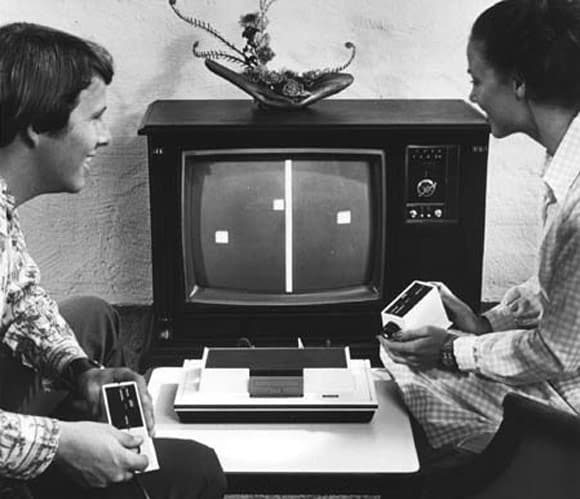
The Magnavox Odyssey, released in 1972, was the first home video game console. It was created by Ralph H. Baer. The Odyssey used cartridges to switch between games. These cartridges did not contain any data. They simply changed the console’s circuitry. This allowed players to experience different games. The Odyssey came with plastic overlays for the TV screen. These overlays added color to the black-and-white games. It also included accessories like dice, cards, and game boards. These were used to enhance the gaming experience.
Pong Consoles
Pong consoles were popular in the 1970s. The most famous was Atari’s Pong, released in 1975. Pong was based on a simple table tennis game. Players controlled paddles to hit a ball back and forth. The game was easy to understand and addictive. Many companies created their own versions of Pong. This led to a flood of similar consoles on the market. Pong consoles helped introduce video games to a wider audience. They were an important step in the evolution of gaming.
Popular Games Of The Era
The first generation of video games introduced many popular games. These games laid the foundation for the gaming industry. They were simple yet innovative. This era saw the birth of iconic titles that are still remembered today. Let’s explore some of the popular games of the era.
Iconic Titles
One of the most iconic titles is Pong. Released in 1972, it was a simple tennis game. Players controlled paddles to hit a ball back and forth. Pong became a massive hit and is often credited with starting the video game industry.
Another famous game is Spacewar!, developed in 1962. It featured two spaceships engaged in a battle. Players controlled the ships and tried to shoot each other down. Spacewar! was a favorite among early computer enthusiasts.
Odyssey’s Table Tennis is also noteworthy. Released in 1972, it was part of the first home video game console. Players moved paddles to hit a ball on the screen. This game paved the way for future home gaming consoles.
Game Mechanics
The game mechanics of this era were simple. Pong’s mechanics involved moving a paddle up and down. The goal was to prevent the ball from passing your paddle.
In Spacewar!, players controlled spaceships with limited fuel. They had to navigate and fire missiles at their opponent. The game also featured a star in the center, creating gravitational pull.
Table Tennis on the Odyssey used basic mechanics. Players moved their paddles using dials. The game used simple collision detection to bounce the ball.
These early game mechanics were straightforward. Yet, they provided hours of entertainment. They also set the stage for more complex games in the future.
Technological Limitations
The first generation of video games had many technological limitations. These limitations shaped the early days of gaming. The hardware and software both faced significant challenges. Let’s explore these constraints in more detail.
Hardware Constraints
Early gaming consoles had very limited hardware capabilities. The processors were slow and had low memory. Graphics were simple and often in black and white. Sound was also very basic, often just beeps and boops.
The controllers were another challenge. They were often just knobs or simple buttons. This limited how players could interact with the game. The screens were small and had low resolution, making detailed graphics impossible.
Software Challenges
Writing software for these early games was difficult. The programming languages were basic and had limited features. This made it hard to create complex games. Many games had simple rules and gameplay.
Developers had to deal with storage limitations. Early games were stored on cartridges or tapes. These storage mediums had very little space. Developers had to be creative to fit their games into such small spaces.
Another challenge was bug fixing. Debugging tools were primitive and did not offer much help. Developers often had to find and fix bugs manually, which was time-consuming.
| Hardware Constraints | Software Challenges |
|---|---|
| Slow processors | Basic programming languages |
| Low memory | Limited storage space |
| Simple controllers | Primitive debugging tools |
| Small screens | Manual bug fixing |
Credit: talentec.es
Cultural Impact
The cultural impact of the first generation of video games was profound. These early games paved the way for a new form of entertainment. They created an industry that would grow beyond anyone’s imagination. Their influence reached far beyond the pixels on the screen. Let’s explore this impact through various lenses.
Entertainment Evolution
First-generation video games introduced interactive entertainment to the masses. Before this, entertainment was mostly passive. People watched TV or read books. Now, they could play and control the action. This shift changed how people spent their leisure time. It made entertainment more engaging.
Games like Pong and Spacewar! were simple but captivating. They offered a new experience. Players could compete against each other. This competitive element added excitement. It was something new and thrilling. The evolution of entertainment had begun.
Public Perception
In the beginning, video games were a novelty. Most people had never seen anything like them. They were curious and intrigued. But not everyone understood their potential. Some saw them as a passing fad. Others thought they were just for kids.
Over time, perceptions changed. As more people played, they saw the value of games. They were not just for fun. They could teach skills and bring people together. Public perception evolved as games became more popular. Video games earned their place in modern culture.
Economic Landscape
The first generation of video games marked a significant milestone. This era saw the birth of an industry. It started small but grew rapidly. Understanding its economic landscape is key.
Market Growth
The market for video games grew quickly. In the early 1970s, few people played video games. But soon, interest skyrocketed. Arcade games became popular. Many businesses saw the opportunity. They began investing in video games. New gaming consoles entered the market. This led to a boom in the industry. People were eager to try new games. The market expanded rapidly.
Industry Revenue
The revenue from video games also increased. In 1972, the first home gaming console was released. It was called the Magnavox Odyssey. Sales were modest at first. But as more people bought consoles, revenue rose. Arcade games generated significant income too. By the mid-1970s, the industry was worth millions. Businesses saw the potential for profit. They continued to invest in video games. This ensured steady growth in revenue.
Legacy And Influence
The first generation of video games laid the groundwork for the gaming industry. Their influence and legacy continue to shape modern gaming. The innovations and creativity of this era created a lasting impact on technology and entertainment.
Foundation For Future Generations
The first generation of video games set the stage for future advancements. Early consoles like the Magnavox Odyssey introduced the concept of home gaming. This innovation sparked interest and investment in video game development.
Game developers began to explore new ideas and technologies. Simple games with basic graphics led to more complex and engaging experiences. These early efforts paved the way for the rich, immersive games we enjoy today.
Enduring Impact
The impact of the first generation of video games is still felt today. Many modern game mechanics can trace their roots to these early titles. The foundational principles established during this time remain relevant.
Classic games from this era inspire contemporary developers. They study these early games to understand what makes a game fun and engaging. The simplicity and creativity of first-generation games continue to influence design choices today.
Overall, the legacy of the first generation of video games is undeniable. Their contributions helped shape an industry that continues to grow and evolve. The influence of these early games is a testament to their lasting importance.
Challenges Faced
The first generation of video games faced many challenges. These obstacles shaped the industry and paved the way for future advancements. Understanding these challenges gives us insight into the early days of gaming.
Technical Hurdles
Technical limitations were a major challenge for first-generation video games. Early gaming systems had very basic hardware. Developers had to work with limited memory and simple graphics. This made creating engaging games difficult. These systems could only handle a few colors and sounds. The graphics were often blocky and lacked detail.
Another issue was the lack of powerful processors. Early consoles did not have the speed to process complex actions. This led to simple and repetitive gameplay. Game developers had to be creative to make fun games with these constraints.
Input devices were also a challenge. Early controllers were basic and had few buttons. This limited the types of games that could be created. Developers had to design games that were easy to control with limited inputs.
Market Acceptance
Convincing people to buy video games was another big challenge. In the early days, video games were a new concept. Many people did not understand what they were or why they should play them. This made it hard to sell gaming systems and games.
The cost of early gaming systems was also a barrier. These devices were expensive, and many families could not afford them. This limited the market for video games. To overcome this, companies had to prove that video games were worth the investment.
Another issue was competition from other forms of entertainment. In the 1970s, people enjoyed TV, movies, and board games. Video games had to compete with these established forms of entertainment. Companies needed to create games that stood out and offered something unique.
Retailers were also hesitant to stock video games. They were unsure if these products would sell. This made it difficult for gaming companies to get their products into stores. To succeed, they had to build relationships with retailers and convince them of the market potential.
Conclusion And Reflections
The first generation of video games marked a pivotal moment in technology. These early games laid the groundwork for today’s advanced gaming industry. Their simple designs and limited graphics were charming yet innovative. They opened up a new world of entertainment and interaction. Let’s reflect on their achievements and what might come next.
Summary Of Achievements
The first generation of video games had many significant accomplishments. They introduced the concept of home entertainment. Devices like the Magnavox Odyssey made gaming accessible at home. These early systems brought families together. They created a new form of social interaction. Simple games like Pong became household names. They paved the way for complex video games of today. These pioneers showed that games could be more than just fun. They could be a shared experience.
Future Projections
The future of video games looks bright. Advancements in technology will continue to evolve. Virtual reality and augmented reality will become more common. Games will be more immersive and realistic. The legacy of the first generation will always be remembered. They set the stage for endless possibilities in gaming. As technology grows, so will the creativity in game design. The early efforts of the first generation will always inspire future innovations.
Frequently Asked Questions
What Are First Generation Video Games?
First generation video games are early home consoles from the 1970s.
Which Was The First Commercial Video Game?
The first commercial video game was Pong, released in 1972.
How Did First Generation Consoles Work?
First generation consoles used simple circuitry and did not have microprocessors.
What Was The Magnavox Odyssey?
The Magnavox Odyssey was the first home video game console, released in 1972.
Were First Generation Games In Color?
No, most first generation games were in black and white.
Did First Generation Consoles Have Sound?
Some first generation consoles had basic sound effects, but many were silent.
How Many Games Did First Generation Consoles Have?
First generation consoles had a small number of built-in games, often less than ten.
Conclusion
The 1st generation of video games set the stage. It brought simple yet engaging gameplay. These early games sparked a global interest in gaming. They paved the way for the future of entertainment. Many people cherish these classic games. They remind us of simpler times.
The legacy of the 1st generation lives on. It influences the games we play today. Understanding this history helps appreciate modern games more. So, keep playing and enjoy the journey through gaming history!