
5G will revolutionize connectivity by providing ultra-fast speeds and low latency. It will enable advanced technologies like IoT and autonomous vehicles.
5G technology promises to transform various aspects of our daily lives and industries. Enhanced mobile broadband will deliver faster downloads and seamless streaming. It will support massive IoT deployments, connecting billions of devices efficiently. Smart cities will thrive with improved infrastructure and real-time data analytics.
Autonomous vehicles will become safer and more reliable with instant communication. Remote healthcare will advance, offering better telemedicine services. Businesses will benefit from innovative applications and increased productivity. The global economy will see significant growth as 5G unlocks new opportunities. This groundbreaking technology will drive progress and innovation across multiple sectors.

Credit: www.youtube.com
Faster Speeds
The advent of 5G technology promises to revolutionize the world with its faster speeds. This breakthrough will significantly enhance our digital experiences and connectivity. From lightning-fast download and upload rates to seamless streaming, the impact of 5G will be felt across various domains.
Download And Upload Rates
With 5G, download and upload speeds will increase drastically. 5G networks can achieve speeds up to 100 times faster than 4G. Imagine downloading a full-length movie in seconds. Uploading large files will also be quicker. This improvement will benefit everyone, especially those who work remotely or rely on cloud services.
| Technology | Average Download Speed | Average Upload Speed |
|---|---|---|
| 4G | 20-30 Mbps | 10-15 Mbps |
| 5G | 1-10 Gbps | 100-1000 Mbps |
Impact On Streaming
5G will transform the way we stream content. Buffering and lagging will become things of the past. Streaming high-definition and 4K videos will be smoother. Live streaming events will also see a boost in quality. Gamers will experience less latency, making online gaming more enjoyable.
- No more buffering during video playback
- High-quality video streaming (HD and 4K)
- Enhanced live streaming quality
- Reduced latency in online gaming
Credit: www.visualcapitalist.com
Lower Latency
The advent of 5G technology promises to revolutionize our world. One of its most significant impacts will be lower latency. This means faster response times and a more seamless experience.
Real-time Communication
Lower latency will transform real-time communication. Video calls will be clearer and smoother. You will experience fewer delays and interruptions. This will improve virtual meetings and online education. Doctors will perform surgeries remotely with precision.
Here is a quick comparison of latency improvements:
| Technology | Latency |
|---|---|
| 4G | 50 ms |
| 5G | 1 ms |
Benefits For Gamers
Gamers will experience huge benefits with lower latency. Online games will respond faster to player actions. This will provide a smoother and more competitive gaming experience.
Here are some key benefits for gamers:
- Reduced lag
- Improved gameplay response
- Better performance in multiplayer games
These improvements will make online gaming more enjoyable and immersive.
Enhanced Connectivity
The advent of 5G technology promises enhanced connectivity for everyone. This next-gen network will revolutionize many aspects of our daily lives. One of the most exciting impacts will be seen in the areas of the Internet of Things (IoT) and Smart Cities.
Internet Of Things (iot)
5G will supercharge the Internet of Things (IoT). It will connect more devices than ever before. These devices will include smart home gadgets, wearable tech, and industrial machines.
The data transfer speeds will be much faster. This means that devices can communicate in real-time. Imagine your smart fridge ordering groceries for you. Or your thermostat adjusting itself based on your schedule.
IoT devices will also become more reliable. 5G’s low latency will ensure quick responses. This will be crucial for applications like autonomous vehicles and remote surgeries.
Smart Cities
5G will be the backbone of smart cities. These cities will use data to manage resources efficiently. Traffic lights, for example, will adjust in real-time. This will reduce congestion and improve air quality.
Public services will become more efficient. Waste management systems will alert when bins are full. Water systems will monitor leaks and usage patterns.
Safety will also improve. Surveillance cameras will provide real-time footage. Emergency services will respond faster thanks to connected devices.
Smart cities will create a better living environment. They will be more sustainable and efficient. All of this will be possible because of 5G technology.
Healthcare Innovations
5G technology promises to revolutionize healthcare with groundbreaking innovations. The healthcare industry will see significant improvements in patient care and medical practices. Two key areas of transformation are remote surgery and telemedicine.
Remote Surgery
Remote surgery will become a reality with 5G. Surgeons can operate on patients from different locations. This is possible because 5G offers ultra-low latency. The delay between action and response is almost zero. Real-time video and precise movements are crucial in surgery. 5G ensures both are flawless.
Hospitals in rural areas will benefit the most. Expert surgeons can perform complex procedures remotely. Patients won’t need to travel long distances. This will save time, money, and lives.
Telemedicine
Telemedicine will flourish with 5G. Doctors can consult patients via video calls. 5G provides high-quality, uninterrupted video. Clear visuals help in accurate diagnosis.
Patients can access healthcare from their homes. This is especially useful for elderly and disabled patients. They no longer need to visit hospitals for regular check-ups. Wearable devices can monitor health data in real-time. Doctors receive this data instantly and can respond quickly.
Here is a comparison of the benefits:
| 5G Feature | Benefit |
|---|---|
| Ultra-low latency | Real-time remote surgery |
| High-quality video | Clear telemedicine consultations |
| Real-time data transfer | Instant health monitoring |
The future of healthcare is bright with 5G. Patients and doctors will experience unprecedented improvements.
Automotive Advancements
The rise of 5G technology promises to revolutionize the automotive industry. With faster internet speeds, automotive advancements will reach new heights. Key areas of improvement include self-driving cars and traffic management. Let’s dive into how 5G will transform these sectors.
Self-driving Cars
Self-driving cars rely on quick data exchange. 5G technology offers ultra-fast speeds and low latency. This ensures that cars can communicate instantly with each other and their environment. Autonomous vehicles will be safer and more efficient.
5G enables real-time updates for self-driving cars. They can better navigate through traffic and avoid accidents. The technology also supports advanced sensors and cameras. These tools help cars understand their surroundings better.
Key benefits of 5G for self-driving cars:
- Reduced response time
- Improved safety
- Enhanced navigation
Traffic Management
Traffic management will see significant improvements with 5G. Data from connected vehicles can be analyzed in real-time. This helps authorities manage traffic flow better. Smart traffic lights can adapt to changing conditions. This reduces congestion and improves travel times.
5G also supports vehicle-to-infrastructure (V2I) communication. This means cars can communicate with road signs and traffic lights. The result is smoother traffic flow and fewer accidents.
Key benefits of 5G for traffic management:
- Real-time traffic updates
- Adaptive traffic lights
- Improved road safety
Industrial Applications
The advent of 5G technology promises to revolutionize industrial applications. Enhanced speed and connectivity will drive efficiency and innovation. Industries will experience unprecedented growth and transformation.
Smart Factories
Smart factories will utilize 5G to enhance automation and connectivity. Machines will communicate seamlessly, reducing downtime and increasing productivity. Real-time data analysis will drive better decision-making.
- Automation: Robots will perform tasks with precision and speed.
- IoT Integration: Devices will connect and share data instantly.
- Predictive Maintenance: Sensors will predict equipment failures before they occur.
Supply Chain Optimization
5G will transform supply chain management with real-time tracking and data analytics. Businesses will optimize routes and inventory, reducing costs and delays.
- Real-Time Tracking: Monitor shipments in real-time for better transparency.
- Data Analytics: Analyze data to predict demand and supply needs.
- Enhanced Communication: Suppliers and manufacturers will communicate instantly.
These advancements will streamline operations and enhance efficiency. Industrial applications of 5G will set new standards in productivity and innovation.
Entertainment And Media
The advent of 5G technology is set to revolutionize the entertainment and media industry. This new era of connectivity promises faster speeds, lower latency, and enhanced user experiences. Let’s explore how 5G will transform entertainment and media, focusing on Virtual Reality (VR) and Augmented Reality (AR).
Virtual Reality
Virtual Reality (VR) immerses users in a digitally created world. With 5G, VR experiences will become more realistic and interactive. Faster data transfer rates will allow for higher resolution graphics and more detailed environments.
Imagine watching a live concert as if you were in the front row. 5G will enable seamless streaming of such experiences without lag or buffering. Gamers will also benefit from 5G, enjoying smoother gameplay and richer graphics.
Here are some ways 5G will enhance VR:
- High-Quality Streaming: Enjoy live events in VR with no lag.
- Improved Graphics: Experience more detailed and lifelike environments.
- Enhanced Interactivity: Engage with VR content in real-time.
Augmented Reality
Augmented Reality (AR) overlays digital information onto the real world. With 5G, AR applications will become more responsive and immersive. High-speed connectivity will allow for real-time updates and interactions.
Imagine walking through a museum and receiving interactive information on exhibits. 5G will make such experiences more dynamic and engaging. Retail and advertising industries will also benefit from enhanced AR capabilities.
Here are some ways 5G will boost AR:
- Real-Time Updates: Get instant information and interactions.
- Smoother Animations: Experience fluid and realistic AR content.
- Enhanced User Engagement: Interact with digital overlays seamlessly.
Credit: www.geeksforgeeks.org
Education Transformation
The advent of 5G technology promises to revolutionize education. Its high-speed internet and low latency will open up new avenues for learning. This will benefit students, teachers, and educational institutions alike.
Remote Learning
Remote learning will become more accessible and effective with 5G. Faster internet speeds mean students can attend virtual classes without interruptions. They will have access to high-quality video and audio, making remote learning more engaging.
- Seamless video streaming
- High-quality audio
- Real-time interactions
This will help students in rural or underdeveloped areas. They can access the same quality of education as those in cities.
Virtual Classrooms
Virtual classrooms will thrive with 5G. Teachers can use augmented reality (AR) and virtual reality (VR) to create immersive learning experiences. This will make learning more interactive and fun.
| Feature | Benefit |
|---|---|
| Augmented Reality (AR) | Interactive lessons |
| Virtual Reality (VR) | Immersive experiences |
Students can explore historical sites, conduct virtual science experiments, and much more. This will make learning more engaging and memorable.
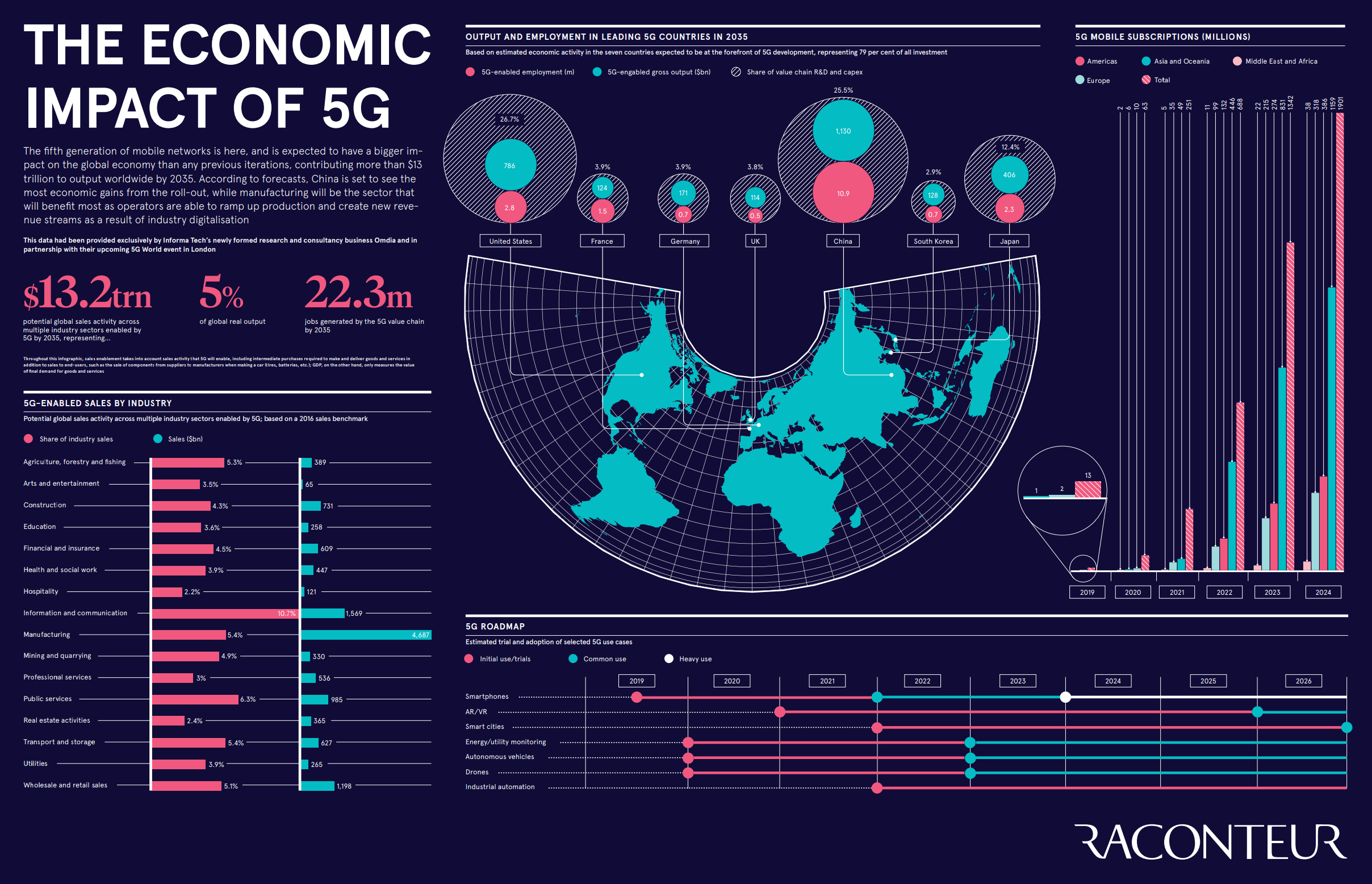
Economic Impact
The advent of 5G technology is set to revolutionize the global economy. By offering faster internet speeds and lower latency, 5G will unlock new opportunities across various sectors. This transformation will be driven by job creation and new business models.
Job Creation
5G will lead to the creation of millions of new jobs. These jobs will span various industries, including technology, healthcare, and manufacturing. For instance, the implementation of 5G networks will require skilled technicians and engineers.
- Technicians will install and maintain 5G infrastructure.
- Engineers will design and optimize 5G systems.
- Customer support roles will increase to handle new services.
Beyond technical roles, 5G will also boost employment in sectors like retail, education, and entertainment. This surge in job creation will stimulate economic growth and provide new opportunities for communities worldwide.
New Business Models
With 5G, new business models will emerge, disrupting traditional industries. Companies will leverage high-speed connectivity and low latency to innovate.
| Industry | Potential Business Models |
|---|---|
| Healthcare | Remote surgeries, telemedicine, real-time patient monitoring |
| Automotive | Autonomous vehicles, smart traffic management, connected cars |
| Entertainment | Augmented reality, virtual reality, 4K streaming |
These new models will not only create wealth but also improve quality of life. Businesses will need to adapt quickly to harness these opportunities. Early adopters of 5G will likely have a competitive edge in their respective markets.
Security Concerns
The advent of 5G technology brings exciting advancements. But it also raises significant security concerns. Faster speeds and increased connectivity can make our data more vulnerable. Let’s explore these concerns in detail.
Data Privacy
With 5G, more devices connect to the internet. This means more data collection. Our phones, smart homes, and cars will all share information.
Companies may track our locations and habits. This raises data privacy issues. Hackers could also access this data. Protecting our personal information becomes more challenging.
Network Vulnerabilities
5G networks rely on many small cell towers. This makes the network more complex. Each tower can be a potential vulnerability.
Hackers could attack these small towers. They might disrupt services or steal data. Securing every tower is a huge task.
Experts worry about DDoS attacks. These attacks flood networks with traffic. 5G’s speed and capacity could make these attacks more dangerous.
| Threat | Description |
|---|---|
| Data Breaches | Unauthorized access to personal information. |
| DDoS Attacks | Flooding the network with excessive traffic. |
| Network Intrusion | Unauthorized access to network infrastructure. |
- 5G increases the number of connected devices.
- Each device can be a target for hackers.
- Network providers must enhance their security measures.
Global Challenges
The advent of 5G technology promises to revolutionize our world. Yet, the path to this transformation is fraught with challenges. These challenges are global in nature and require concerted efforts. Let’s delve into two major global challenges: infrastructure development and regulatory issues.
Infrastructure Development
Building the infrastructure for 5G networks is a colossal task. It involves installing thousands of new cell towers and antennas. This is essential to provide widespread coverage. The process demands substantial investment from governments and private sectors. Developing countries face even greater hurdles. They must first upgrade their existing 4G infrastructure.
In urban areas, deploying 5G requires small cells. These cells need to be placed every few hundred meters. This density is needed for the high-speed and low-latency benefits of 5G. Rural areas face different challenges. They require larger cells that can cover greater distances. This makes rural deployment more expensive and complex.
Table: Comparison of Urban and Rural 5G Infrastructure Needs
| Aspect | Urban Areas | Rural Areas |
|---|---|---|
| Cell Density | High | Low |
| Deployment Cost | Moderate | High |
| Coverage | Limited | Extensive |
Regulatory Issues
Governments must navigate complex regulatory landscapes for 5G deployment. Different countries have varied regulations. These can hinder the global rollout of 5G. Spectrum allocation is a significant regulatory challenge. Governments need to allocate the right frequencies for 5G. This requires international cooperation and coordination.
Another regulatory issue is data privacy. 5G will connect billions of devices. This increases the risk of data breaches. Countries need stringent data protection laws. These laws should protect citizens’ privacy without stifling innovation.
List of Regulatory Challenges:
- Spectrum Allocation
- Data Privacy
- Cross-border Coordination
- Infrastructure Permits
Future Prospects
5G technology promises to transform our world in profound ways. With faster speeds and reduced latency, the future prospects of 5G are limitless. This technology will bring about incredible advancements in various fields, reshaping how we live, work, and play.
Next-gen Applications
One of the most exciting aspects of 5G is its potential for next-gen applications. These applications will leverage the high speeds and low latency of 5G for enhanced performance.
- Smart cities will use 5G to monitor traffic, reduce pollution, and enhance public safety.
- Healthcare will see remote surgeries and real-time patient monitoring.
- Education will benefit from immersive virtual classrooms and interactive learning experiences.
These applications will improve our daily lives in many ways. They will make our environments smarter and more efficient.
Long-term Vision
The long-term vision of 5G extends beyond just faster internet. It aims to create a fully connected world where everything is smart and efficient.
- Autonomous vehicles will communicate with each other for safer roads.
- Industrial automation will increase productivity and reduce errors.
- Virtual and augmented reality will become mainstream, enhancing entertainment and training.
These advancements will lead to new business models and economic growth. 5G technology will be the backbone of future innovations, driving progress in all sectors.
| Sector | Potential Impact |
|---|---|
| Healthcare | Remote surgeries, real-time monitoring |
| Education | Virtual classrooms, interactive learning |
| Transportation | Safer roads, autonomous vehicles |
In summary, the future prospects of 5G are incredibly promising. It will create a world where technology works seamlessly to improve our lives.
Frequently Asked Questions
What Impact Will 5g Have On The World?
5G will revolutionize communication with faster speeds, lower latency, and enhanced connectivity. It will boost smart cities, autonomous vehicles, and IoT. Businesses will benefit from improved efficiency and innovation. Healthcare, education, and entertainment sectors will see significant advancements. The global economy will experience growth through new opportunities and technological advancements.
How Will 5g Affect The Environment?
5G can lead to increased energy consumption and electronic waste. It may affect wildlife due to higher radiation exposure. Sustainable practices are necessary to mitigate environmental impacts.
How Does 5g Affect Our Daily Life?
5G improves daily life by enhancing internet speed, enabling smart cities, boosting remote work, and supporting advanced technologies. It offers faster downloads, real-time communication, and better connectivity for devices. This leads to more efficient and convenient daily activities.
How Will 5g Transform The Global Economy?
5G will boost the global economy by enhancing connectivity, enabling smart cities, and driving innovations in various industries. Faster data speeds and lower latency will improve efficiency, productivity, and create new business opportunities. Enhanced IoT integration will revolutionize sectors like healthcare, manufacturing, and transportation.
What Is 5g Technology?
5G is the fifth generation of mobile network technology, offering faster speeds and lower latency.
How Will 5g Affect Internet Speed?
5G will significantly increase internet speeds, making downloads and streaming much faster.
Can 5g Improve Smart Cities?
Yes, 5G enhances smart city infrastructure with better connectivity for IoT devices, improving services and efficiency.
Will 5g Impact Healthcare?
5G enables remote surgeries and real-time health monitoring, revolutionizing healthcare delivery and patient care.
Conclusion
5G technology promises to revolutionize our daily lives. Faster speeds and lower latency will enhance connectivity. Industries like healthcare, transportation, and entertainment will see significant advancements. Embracing 5G will pave the way for innovative solutions and smarter cities. Stay informed and be ready to experience the transformative power of 5G.